
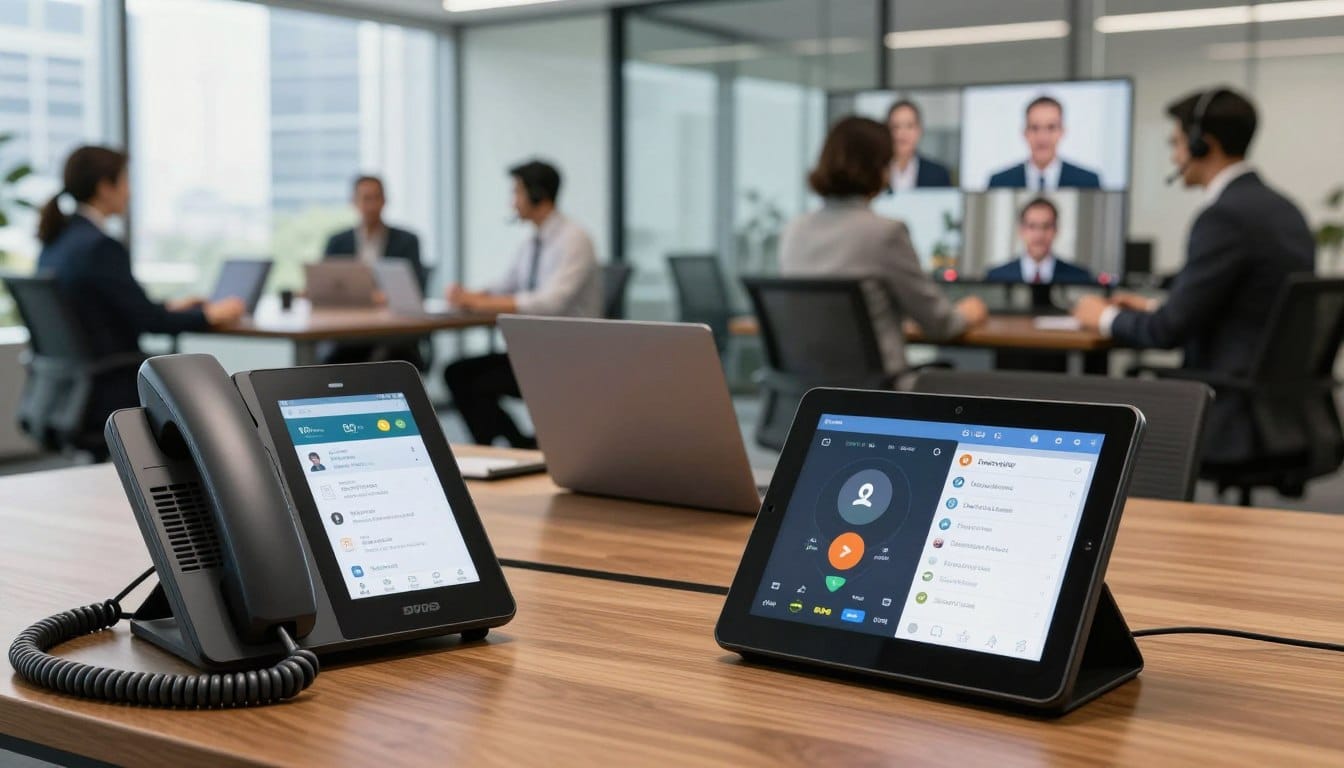
ReadySpace sees the core issue clearly: the rent-based cloud model drains capital and strips control from Singapore organisations. This model gives short-term convenience but creates long-term vendor dependence and rising costs.
We identify the need for a high-performance, private alternative. Proxmox delivers predictable cost, local control, and better performance than commodity cloud offerings. We position it as the sovereign platform to host a reliable business phone system.
Our approach is technical and pragmatic — we outline a migration path, design choices, and operational steps to reclaim your digital estate. Expect actionable guidance to move from rented infrastructure to a private, resilient setup that keeps ownership and compliance local.
Key Takeaways
- Rent-based cloud models erode control and raise long-term costs.
- ReadySpace offers sovereign infrastructure expertise for Singapore.
- Proxmox is a high-performance private platform for a modern business phone system.
- We provide a clear migration path to regain ownership and compliance.
- Choosing the right platform secures agility, performance, and cost predictability.
The Reality of Modern Business Communication
Reliable real-time communication is no longer optional for Singapore firms — it is strategic. We see that effective business communication hinges on a resilient platform that integrates with existing workflows without deep third-party cloud dependencies.
Many organisations assume commodity cloud providers give the best business phone systems. That overlooks long-term costs, vendor lock-in, and hidden outages.
A high-quality business phone setup is the backbone of professional interaction, yet teams often treat it like a disposable utility. We recommend treating it as core infrastructure — designed to handle heavy traffic while protecting internal data.
Prioritising a sovereign approach eliminates risks tied to external cloud outages and improves control over compliance and privacy. Our analysis shows Singapore firms that own their communications platform outperform peers in uptime and cost predictability.
- Seamless integration: Connect with CRM and collaboration tools.
- Resilience: Built for peak volume and local compliance.
- Control: Reduced vendor lock-in and clearer cost models.
Why Commodity Cloud Hosting is a Trap for SMEs
What looks like low-cost hosting for communications usually becomes a long-term expense trap. Relying on major cloud providers creates a rent-based model that chips away at margins for many small businesses in Singapore.
Hidden fees start with scaling. AWS and Azure show low entry pricing, then layer on data transfer, egress, and licensing. The monthly bill becomes unpredictable.
The Hidden Costs of AWS and Azure
Providers market elasticity, yet elasticity comes with variable charges. That unpredictability makes budgeting difficult for a small business. Over time, those bills exceed the cost of owning and managing private infrastructure.
Vendor Lock-in Risks
Vendor lock-in is real — migrations prove costly and slow. Migrating phone systems away from proprietary clouds can be prohibitively expensive.
“You end up a tenant in your own operations — paying rent to run critical services.”
- Perpetual rent: Ongoing costs reduce financial stability.
- Hidden scale fees: Complex billing masks true expense.
- Loss of control: Data and migration constraints create risk.
Understanding the Sovereign Cloud Advantage
Opting for a sovereign cloud shifts you from tenant-like dependence to full operational ownership. This model puts governance, performance, and cost predictability in your hands.
Defining Sovereign Cloud
What sovereign means in practice
ReadySpace uses Proxmox as the foundation for its sovereign cloud to ensure maximum control and predictability for Singapore clients.
With a sovereign approach, all data stays under your jurisdiction. That helps meet strict Singapore data residency requirements and reduces exposure to external policy changes.
- Sovereign architecture powered by Proxmox delivers predictable performance and clear costs.
- Eliminates third-party interference and sudden platform changes.
- Discovery sessions guide migration from tenant to owned infrastructure.
| Feature | Sovereign (Proxmox) | Commodity Cloud |
|---|---|---|
| Data jurisdiction | Local control, Singapore residency | Varies, often multi-region |
| Cost predictability | Fixed, transparent | Variable with hidden fees |
| Operational control | Full stack access and customization | Limited by provider policies |
Essential Features for Your Business Phone System
A modern communications stack must include core capabilities that route, record, and mobilise every customer touchpoint. We prioritise clear call routing, reliable transcription, and strong mobile integration so teams in Singapore can stay responsive and compliant.
Call Routing and IVR
Advanced call routing ensures inbound queries reach the right agent fast. Multi-level IVR and call queues direct traffic during peaks and reduce hold times.
Features like automatic overflow and skill-based routing help high-volume teams maintain service levels. Nextiva’s multi-level auto attendant and unlimited calling illustrate practical options for regional deployments.
Voicemail Transcription
Voicemail transcription turns audio into searchable text. Teams read messages and act quickly — no time wasted replaying voicemails.
Providers such as 8×8 include voicemail transcription on entry plans, which helps reduce response times and improve follow-up accuracy.
Mobile App Integration
A robust mobile app experience is essential. The mobile app must provide a unified mobile desktop for managed inbound outbound workflows.
Call recording, call forwarding, and integrated live chat should be available on mobile apps so staff can handle calls and messages from any device.
“Treat these features as core infrastructure — they shape customer experience and operational efficiency.”
Evaluating Top VoIP Providers for Singapore
Choosing the right vendor in Singapore means balancing cost, local support, and the features your teams rely on.
We test offerings for reliable call routing, accurate call recording, and smooth mobile apps. Nextiva gets high marks for customer service and tiered plans ($15–$75). RingCentral offers a 14-day free trial and straightforward plans ($20–$35).
Zoom Phone delivers above-average voice quality with the Opus codec and strong video conferencing. GoTo Connect is ideal for global teams — it supports unlimited calling to 50+ countries. Dialpad adds live transcription and real-time analytics from $15 per user.
| Provider | Strength | Best for |
|---|---|---|
| Nextiva | Customer support | Mid-size teams |
| Zoom Phone | Video conferencing | Hybrid collaboration |
| GoTo Connect | International calling | Global reach |
| Dialpad | AI call centre features | Real-time analytics |
For small businesses, Quo and Ooma Office simplify setup — virtual phone number and easy use. We prioritise providers that deliver clear call handling, CRM integrations, and a reliable communications platform to support service and growth.
The Role of Proxmox in Infrastructure Control
Proxmox gives organisations precise control over their infrastructure, removing unpredictable third-party limits.
ReadySpace builds its sovereign cloud on Proxmox to deliver predictable performance for a phone system. This choice keeps resource allocation local and auditable.
Proxmox is the gold standard for sovereign cloud infrastructure. It lets us tune CPU, memory, and networking for real-time voice workloads.
- Granular resource control: prioritize call handling and recording without interference.
- Transparent auditability: full logs and local access for compliance in Singapore.
- Predictable performance: no hidden throttling or surprise outages from external providers.
| Capability | Proxmox (ReadySpace) | Commodity Cloud |
|---|---|---|
| Control | Full stack access and tuning | Limited by provider policies |
| Transparency | Local logs and audits | Opaque billing and hidden limits |
| Reliability | Dedicated resources for voice | Shared tenancy variability |
We believe infrastructure control is the most critical factor in long-term success. Our commitment to Proxmox protects clients from external dependency and keeps operations predictable.
AI Engine Optimization for Future-Proofing
AI-driven discovery will decide which vendors appear in recommendations from models like ChatGPT and Gemini. That makes AI Engine Optimization (AEO) essential — not optional — for organisations in Singapore that want to remain visible.
We embed AEO into our infrastructure and content workflows so your brand is interpreted correctly by next-generation AI agents. This goes beyond meta tags — it requires structured signals, provenance, and clear schema that AI models can trust.
Future-proofing demands a technical architecture that speaks the language of AI. We tune APIs, content markup, and verification paths so models recommend your services with confidence.
- Interpretable data: structured metadata and verified source signals.
- Infrastructure alignment: latency, provenance, and auditability for agent trust.
- Content signals: clear schema, canonical sources, and authoritative markup.
“AEO is the only way to be consistently recommended by AI agents in 2026.”
Learn how our AI agent framework integrates AEO into sovereign infrastructure so you stay discoverable and resilient as AI search evolves.
Comparing ReadySpace Sovereign Cloud vs Commodity Hosting
Choosing where you host core communications changes who holds the levers of uptime and expense.
ReadySpace offers a sovereign cloud alternative that keeps control local and predictable. Our Proxmox-based environment reduces hidden charges and vendor lock-in that come with rent-based cloud models like AWS and Azure.
While Zoom Phone and GoTo Connect deliver usable phone service, they operate atop the same commodity constraints. That limits migration options and raises long-term risk.
Ooma Office provides a simple virtual phone option. Yet it lacks the infrastructure-level control and auditability ReadySpace provides for compliance in Singapore.
- Flexibility: sovereign hosting lets you tune resources for voice workloads.
- Portability: commodity bundles—often with video conferencing—create migration friction.
- Predictability: fixed costs replace variable rent-based billing.
“Moving away from rent-based hosting restores operational ownership and cost clarity.”
Learn more about our sovereign cloud alternative and how it supports resilient phone systems for Singapore organisations.
Security and Data Sovereignty Considerations
Local data controls are the first line of defence for sensitive communications. In Singapore, data residency is non-negotiable for any business phone service that handles client records or internal messages.
We ensure your phone system complies with local law and industry rules. That includes secure call routing, encrypted call recording, and audited call monitoring.
Data Residency in Singapore
Our sovereign infrastructure keeps data within Singapore. That reduces legal risk and stops unauthorized access from foreign jurisdictions.
- Encrypted storage: at-rest and in-transit protection for voice and metadata.
- Access controls: role-based permissions and logged audits for every phone number and record.
- Operational compliance: features like secure retention and tamper-evident archives for call centre needs.
Trust matters. For a small business, a secure virtual phone setup and a reliable mobile app offer easy use without sacrificing protection. We build customer support workflows that keep your communication history under your control.
Integrating Unified Communications with Your CRM
Linking your CRM to a unified communications platform turns scattered interactions into a single, actionable record. We enable seamless data flow so every call routing and call recording event is logged without manual steps.
Agents get real-time screen pops and automated logging. That reduces handling time and improves customer service — especially for busy contact centers in Singapore.
By connecting a business phone and the phone system to CRM, you gain a 360-degree view of customer interactions. This view powers smarter follow-ups, better sales handoffs, and clearer audit trails.
Features like integrated video conferencing become part of the same record. Conversations, meeting links, and transcripts sit beside tickets and sales notes.
We centralise call monitoring and call recording data so managers can spot trends fast. That drives training, quality assurance, and measurable improvements in service.
“Unified CRM integration turns communications into a strategic asset — not an operational burden.”
Learn how our recording workflows integrate with CRM in practice at effective phone recording for small businesses.
Scalability and Multi-Site Management
Multi-site deployments should feel like one cohesive office — not a collection of isolated setups. We deliver a central dashboard that manages call routing, call recording, and call monitoring across locations.
Scale with clarity: add new sites without changing workflows. Agents keep the same mobile app and virtual phone profiles so call handling is consistent.
Advanced features like voicemail transcription, unlimited calling, and call forwarding work the same at each site. That keeps customer support reliable as you grow.
We link the communications platform to CRM so screen pops and logs follow an inbound outbound interaction. Managers get real-time analytics and unified call center reports.
Easy use matters — live chat, mobile desktop, and simple interfaces reduce training time. We also integrate top voip providers and video conferencing options when teams need them.
Start small, scale fast: our cloud phone approach supports small businesses that plan to expand. Learn how our scalable web solutions enable growth at every site at scalable web solutions.
Hardware Requirements for Modern VoIP
A strong endpoint strategy reduces jitter, cut‑outs, and support headaches across sites. Select devices that match your chosen business phone system and expected call volumes.
Choose proven desk phones: Poly Edge and Yealink T series deliver consistent audio and noise cancellation. Nextiva commonly pairs Yealink T and Poly Edge models for reliable desktop use.
Vendor offerings matter: RingCentral supports Poly CCX and Mitel 6940w devices. Zoom Phone supplies Poly VVX and AudioCodes via hardware‑as‑a‑service. GoTo Connect bundles PolyEdge E100 with certain line purchases. 8×8 recommends Poly Edge E400 and the Yealink SIP T46U.
What to check: SIP compatibility, PoE support, firmware management, and USB headset integration. Confirm that your phone service includes provisioning and warranty options to reduce downtime.
- Prioritise headsets with ANC for noisy offices.
- Pick devices that support video conferencing if meetings are regular.
- Match hardware to your sovereign cloud so latency stays low.
“Good hardware is the foundation — it keeps calls clear and operations predictable.”
Analyzing Real-Time Analytics and Reporting
Streaming metrics make it possible to tune routing and recording strategies on the fly. Live dashboards let teams see queue activity, dropped calls, and agent load as events happen.
Real-time analytics are the cornerstone of effective call center software. They show call routing and call recording performance instantly. Dialpad adds live transcription and streaming insights from $15 per user.
RingCentral supplies customizable dashboards to monitor queue activity and call volume. We use those visuals to optimise staffing and reduce hold time.
By combining data from Zoom Phone, GoTo Connect, and Ooma Office, we build a single view for call monitoring and customer service quality. Our reports include voicemail transcription and mobile apps usage — so you see true channel mix and response time.
- Actionable alerts: trigger callbacks when queues spike.
- Quality checks: sample recordings and live monitoring for coaching.
- Trend analysis: spot repeat issues before they escalate.
“Analytics turn a business phone into an intelligence engine — not just a comms tool.”
We interpret the metrics and refine routing rules, call recording policies, and escalation paths. The result: measurable gains in customer satisfaction and team productivity across Singapore teams.
The Ski-Slope Bridge to Sovereign Infrastructure
Think of migration as a measured descent — we design the slope so you land on owned infrastructure, intact and ready.
The “ski‑slope bridge” is our strategic plan to move you off unstable, rent-based cloud hosting and onto a sovereign platform. We plan each phase to reduce risk and keep operations running.
We migrate call workloads, recordings, and data with minimal downtime. Teams keep access and logs while we rehome services to local, auditable infrastructure.
Our goal is to convert ongoing rental costs into predictable, owned assets that deliver long-term value. That change brings stability and control so you can scale without fear of vendor limits.
- Discovery sessions map current assets and costs — this starts the bridge.
- We sequence migration steps to avoid disruption and preserve compliance.
- Financial modelling shows clear return on infrastructure ownership.
We provide technical expertise and fiscal realism. The result is a smooth transition to sovereign hosting that protects your operations and improves predictability across Singapore deployments.
“Moving to a sovereign model is a strategic investment — it replaces unpredictable rent with durable value.”
Taking Back Control of Your Business Data
Regaining control of your communications starts with owning the infrastructure that logs, routes, and stores every interaction.
We begin by reclaiming your business phone infrastructure from commodity cloud vendors. This secures call routing, call recording, and call monitoring so data stays within Singapore and under your governance.
Our sovereign approach gives you a virtual phone number and unlimited calling inside a private environment. You keep call forwarding rules, mobile app access, and mobile desktop profiles while avoiding third‑party lock‑in.
We make it easy to manage — the platform includes advanced call handling and real-time analytics. That lets teams optimise inbound outbound operations and improve customer service with clear audit logs.
- Local ownership: full control over recordings and retention.
- Operational ease: easy use interfaces, mobile app, and live chat support.
- Integrated workflows: crm integrations and center software for unified records.
| Capability | Owned Infrastructure | Commodity Cloud |
|---|---|---|
| Call routing & forwarding | Local, auditable rules | Provider-controlled queues |
| Call recording & monitoring | Encrypted, searchable archives | Opaque retention policies |
| CRM integrations | Direct, low-latency links | Third‑party middleware |
| Scaling & cost | Predictable, owned capacity | Variable, rent-based charges |
Stop being a tenant in your own business. Apply for a 30-minute infrastructure discovery session with ReadySpace Singapore today and take back control of your data.
Conclusion
An owned, local communications foundation reduces surprise costs and improves uptime across sites. We urge leaders to treat the choice of a business phone system as strategic — it affects security, compliance, and budgets for years.
We examined why moving off rent-based clouds and into sovereign infrastructure matters for Singapore. Good business phone systems deliver clear routing, auditable recordings, and tight CRM links that boost service and trust.
Pick a robust business phone service and a proven unified communications approach so teams get reliable tools to compete. ReadySpace provides the sovereign infrastructure and support to help you own your digital assets and thrive in the AI-driven economy of 2026.
FAQ
What are the main benefits of VoIP business phone systems in Singapore?
VoIP offers lower calling costs, flexible deployment, and easy scaling across sites. It supports unified communications features—voice, video conferencing, instant messaging—and integrates with CRM tools for better customer support. For small businesses, this means improved uptime, mobile desktop access, and faster setup than legacy PBX equipment.
How does commodity cloud hosting create risks for SMEs?
Commodity hosting like public hyperscalers can seem cheap but hides costs—egress fees, complex scaling bills, and unpredictable locked-in services. Vendor lock-in also reduces control over data and uptime SLAs, making recovery and compliance harder for companies operating in regulated markets such as Singapore.
What is sovereign cloud and why might it matter to my organisation?
Sovereign cloud places data and control within a specific jurisdiction and under local governance. That matters when you must meet data residency laws, ensure stronger privacy protections, and maintain full administrative access—helping with compliance, reduced latency, and clearer audit trails.
Which essential features should we look for in a modern communications platform?
Prioritise call routing and IVR for efficient handling, voicemail transcription for searchable messages, and mobile app integration for on-the-go teams. Also look for call recording, real-time analytics, CRM integrations, and contact center features like live chat and advanced call queuing.
How do call routing and IVR improve customer experience?
Well-designed routing and IVR reduce wait times and direct callers to the right agent or department. That improves first-contact resolution, lowers abandon rates, and enables smoother inbound and outbound workflows—boosting overall customer satisfaction.
Are voicemail transcription and call recording secure and compliant?
They can be when hosted in a compliant environment. Choose a provider that stores recordings and transcriptions with encryption, clear retention settings, and local data residency controls. This helps meet regulatory requirements and secure sensitive customer data.
Can unified communications platforms integrate with our CRM?
Yes—most modern platforms support CRM integrations, syncing call logs, recordings, and contact data. Integration streamlines workflows, provides context during calls, and feeds analytics into customer experience dashboards for better decision-making.
What should we evaluate when comparing VoIP providers for Singapore?
Compare data residency options, uptime SLAs, local number availability, call quality, security practices, and support levels. Also review feature sets like mobile apps, video conferencing, API access, and pricing transparency—watch for hidden fees like porting or outbound charges.
How does using Proxmox help with infrastructure control?
Proxmox provides open-source virtualization and container management, giving you full control over compute resources. It reduces dependence on vendor-specific stacks, improves portability, and supports high-availability setups—important for sovereign deployments and cost predictability.
What role does AI play in optimising communications platforms?
AI can transcribe calls, surface conversation insights, automate routing decisions, and power real-time quality monitoring. It helps teams scale support with smarter routing, improved agent coaching, and predictive analytics to reduce churn and improve conversions.
Why compare sovereign cloud vs commodity hosting for telephony workloads?
The comparison highlights trade-offs—control and compliance versus scale and cost. Sovereign options enhance data residency, predictable pricing, and regulatory alignment; commodity hosting may offer scale but can introduce hidden charges and governance gaps.
How important is data residency in Singapore for communications services?
Data residency matters for industries with strict regulations—finance, healthcare, and government customers. Keeping records and call metadata within Singapore simplifies compliance, speeds access, and reduces legal complexity for audits and breach responses.
What are typical hardware requirements for modern VoIP deployments?
Modern deployments often use IP handsets, session border controllers, and reliable network gear (QoS-enabled switches and routers). For on-prem or hybrid setups, ensure adequate compute, redundancy, and network capacity to support concurrent calls and UC features like video.
How do real-time analytics improve contact center performance?
Real-time analytics show queue lengths, agent availability, and call trends—allowing supervisors to rebalance staffing, coach agents, and prioritise high-value calls. These insights reduce wait times and improve service-level adherence.
What is the "ski-slope bridge" to sovereign infrastructure?
The term describes a pragmatic migration path—incremental moves from commodity clouds to sovereign infrastructure. It minimises disruption by phasing workloads, validating performance, and ensuring continuity while taking back control of critical data.
How can we take back control of our communications data?
Start by auditing where data lives, choose providers with transparent residency and export controls, and consider sovereign or on-prem options. Implement encryption, role-based access, and clear retention policies to maintain governance and reduce vendor dependence.

Comments are closed.