

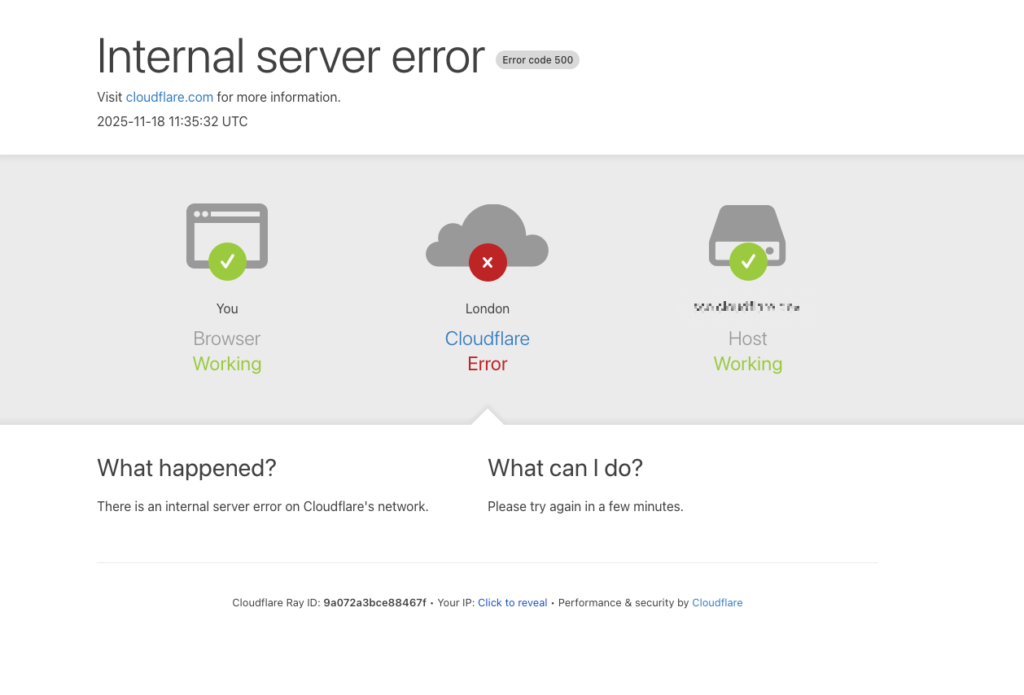
On November 18, 2025, a significant portion of the internet went dark when Cloudflare, a company that handles approximately 20% of global web traffic, experienced a widespread outage. Major platforms including X (formerly Twitter), ChatGPT, Shopify, and thousands of other websites displayed error messages as Cloudflare’s services faltered. This article examines what happened during the Cloudflare outage, its causes, widespread impact, and the important lessons for internet infrastructure resilience.
What is Cloudflare and Why Does it Matter?
Cloudflare is a content delivery network (CDN) and cloud services provider that acts as a crucial intermediary between users and websites. Founded in 2009, the company has grown to become a fundamental part of internet infrastructure, handling approximately 20% of all web traffic globally.
Unlike the direct connection many imagine between their devices and websites, companies like Cloudflare sit in the middle, providing several critical services:
- Protection against distributed denial of service (DDoS) attacks
- Content delivery acceleration by caching data closer to users
- Traffic management and load balancing
- Bot detection and mitigation
- Web application firewall services
When functioning properly, this infrastructure is invisible to most users. However, when it fails, as it did in November 2025, the impact reverberates across the internet, affecting millions of websites and services simultaneously.
Timeline of the Cloudflare Outage 2025
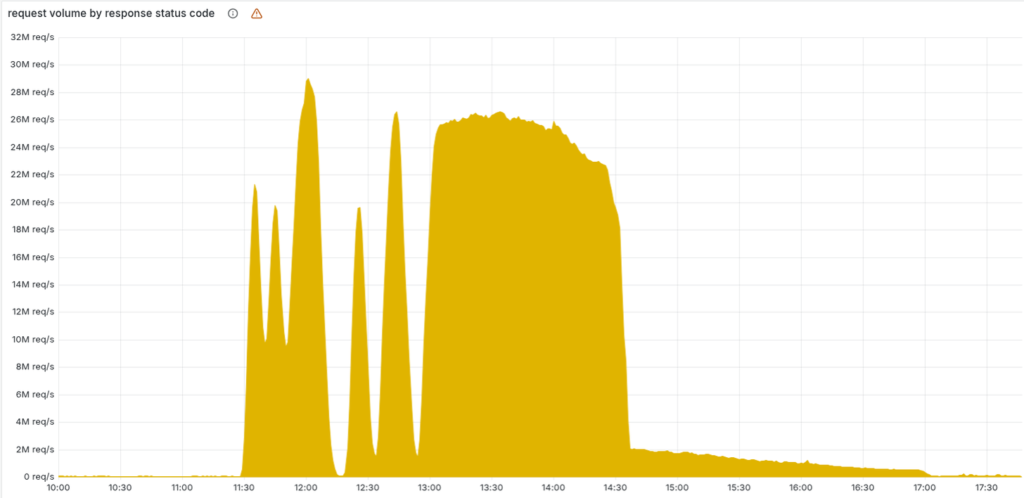
The Cloudflare outage followed a clear progression from initial detection to resolution. Understanding this timeline provides insight into how major infrastructure failures unfold and are addressed.
| Time (UTC) | Event | Impact |
| 10:20 AM | Cloudflare detects “spike in unusual traffic” | Initial monitoring alerts triggered |
| 10:30 AM | First user reports of website errors | Error messages begin appearing across websites |
| 10:48 AM | Cloudflare confirms global outage | Thousands of websites become inaccessible |
| 11:15 AM | Cloudflare disables Warp encryption in London | Attempted mitigation causes connection failures |
| 1:44 PM | Engineers identify root cause | Configuration file issue isolated |
| 2:48 PM | Fix implemented and deployed | Services begin returning to normal |
| 4:30 PM | All services fully restored | Residual traffic spikes normalize |
The outage lasted approximately 4.5 hours from first detection to full resolution, though the most severe impacts were experienced during a 3-hour window. During this period, Cloudflare’s status page itself experienced intermittent availability issues, complicating communication efforts.
Root Cause Analysis: What Triggered the Outage
According to Cloudflare’s post-incident report, the outage was caused by a technical failure in their configuration management system. The company’s Chief Technology Officer, Dane Knecht, described it as “a latent bug in a service underpinning our bot mitigation capability.”
“Earlier today, we failed our customers and the broader internet when a problem in Cloudflare network impacted large amounts of traffic that rely on us. In short, a latent bug in a service underpinning our bot mitigation capability started to crash after a routine configuration change we made.”
The technical details revealed that an automatically generated configuration file designed to manage potential security threats had grown beyond its expected size. This oversized file triggered a crash in the software system responsible for handling traffic across several Cloudflare services.
Importantly, Cloudflare confirmed there was “no evidence that this was the result of an attack or caused by malicious activity.” Instead, it appears to have been an unforeseen consequence of their routine system operations and scaling processes.
Impact Assessment: Services Affected by the Cloudflare Outage
The Cloudflare outage 2025 had far-reaching consequences across the internet ecosystem. Major platforms experienced significant disruption, highlighting the interconnected nature of modern web infrastructure.
Major Platforms Affected
- X (formerly Twitter) – Social media platform
- ChatGPT and Sora – OpenAI’s AI services
- Shopify – E-commerce platform
- Canva – Design platform
- Dropbox – File storage service
- Coinbase – Cryptocurrency exchange
- League of Legends – Online game
- Claude – Anthropic’s AI chatbot
- Truth Social – Social media platform
- Indeed – Job search engine
Critical Infrastructure Impacted
- NJ Transit – Transportation services
- New York City Emergency Management
- SNCF – France’s national railway company
- Moody’s – Credit ratings service
- Financial services platforms
- Healthcare provider portals
- Government service websites
- Educational institution platforms
- News and media websites
- Cloud-based business applications
The outage demonstrated how centralized certain aspects of internet infrastructure have become. With Cloudflare handling approximately 20% of global web traffic, its failure created what cybersecurity expert Mike Chapple described as a “massive digital gridlock” for internet users worldwide.
Cloudflare’s Response and Communication
Throughout the incident, Cloudflare maintained communication through multiple channels, though their own status page experienced intermittent availability issues. The company’s response can be evaluated across several dimensions:
Strengths in Response
- Rapid acknowledgment of the issue (within 18 minutes)
- Regular status updates throughout the incident
- Technical transparency about root cause
- Clear communication that no attack had occurred
- Public apology from leadership
Areas for Improvement
- Status page itself experienced availability issues
- Initial mitigation attempts caused additional problems
- Limited proactive communication to affected customers
- Delayed restoration time estimates
- Inconsistent information across communication channels
In their post-incident statement, a Cloudflare spokesperson said: “Given the importance of Cloudflare’s services, any outage is unacceptable. We apologize to our customers and the internet in general for letting you down today.”
The company committed to a thorough review of their systems and promised to implement changes to prevent similar incidents in the future. This included improvements to their configuration management systems and enhanced testing protocols for critical infrastructure components.
Industry Reactions and Expert Commentary
The Cloudflare outage 2025 prompted significant commentary from industry experts and analysts, who highlighted several key themes:
“We’re seeing how few of these companies there are in the infrastructure of the internet, so that when one of them fails it becomes really obvious quickly.”
Cybersecurity expert Mike Chapple explained the technical architecture that makes such outages so impactful: “When you access a website protected by Cloudflare, your computer doesn’t connect directly to that site. Instead, it connects to the nearest Cloudflare server, which might be very close to your home. That protects the website from a flood of traffic, and it provides you with a faster response. It’s a win-win for everyone, until it fails, and 20 percent of the internet goes down at the same time.”
Dr. Niusha Shafiabady from Australian Catholic University called the incident “a wakeup call,” adding: “We need transparency, backup routes and multi-provider set-ups so one company’s glitch can’t darken the whole web.”
Industry analyst Jacob Bourne from Emarketer noted a concerning trend: “We’re seeing outages happen more frequently, and they’re taking longer to fix. That’s a symptom of strained infrastructure: increased AI load, streaming demand, and ageing capacity all pushing systems past the edge.”
Lessons Learned and Preventive Measures
The Cloudflare outage 2025 offers several important lessons for both service providers and businesses relying on cloud infrastructure:
For Infrastructure Providers
- Implement more rigorous testing for configuration changes
- Establish size limits and validation for critical configuration files
- Develop redundant communication channels for status updates
- Create isolated fallback systems for critical services
- Improve monitoring for unusual file growth patterns
For Businesses Using CDNs
- Implement multi-CDN strategies to avoid single points of failure
- Develop graceful degradation capabilities for critical applications
- Create and test outage response plans
- Maintain direct access routes to critical services
- Establish SLAs with clear compensation for downtime
For the Broader Industry
- Reconsider the centralization of internet infrastructure
- Develop standards for infrastructure diversity
- Create industry-wide incident response protocols
- Improve transparency around dependency chains
- Establish better cross-provider communication channels
Following the incident, Cloudflare announced several specific improvements to their systems, including enhanced file size monitoring, improved configuration validation processes, and additional redundancy for their bot management services.
Historical Context: Comparing Major Outages
The Cloudflare outage 2025 was significant but not unprecedented. Placing it in historical context helps understand the evolving nature of internet infrastructure failures.
| Outage Event | Date | Duration | Root Cause | Estimated Impact |
| Cloudflare Outage | November 2025 | 4.5 hours | Configuration file overflow | 20% of global web traffic |
| AWS Outage | October 2025 | 12+ hours | Database system failure | 33% of cloud workloads |
| Microsoft Azure/365 | October 2025 | 6 hours | Authentication system error | Millions of business users |
| CrowdStrike Incident | July 2024 | 8+ hours | Faulty software update | Global Windows systems |
| Cloudflare Outage | June 2022 | 1.5 hours | Network configuration error | 19 data centers |
| Fastly Outage | June 2021 | 1 hour | Software bug triggered by configuration | Major news/commerce sites |
The pattern of these outages reveals several concerning trends: increasing frequency, longer resolution times, and wider impact due to the growing centralization of internet infrastructure. The 2025 incidents, including Cloudflare’s outage, suggest that as dependency on cloud services grows, so does the potential impact of their failures.
Conclusion: The Fragility of Internet Infrastructure
The Cloudflare outage 2025 serves as a powerful reminder of the internet’s underlying fragility despite its apparent robustness. As our digital economy becomes increasingly dependent on a small number of infrastructure providers, the impact of individual failures grows exponentially.
While Cloudflare’s services were restored within hours, the incident highlighted several critical vulnerabilities in our current internet architecture. The concentration of traffic through a handful of major providers creates single points of failure that can affect millions of websites simultaneously.
For businesses and organizations, the lesson is clear: resilience requires diversity. Implementing multi-provider strategies, maintaining fallback systems, and regularly testing outage scenarios are no longer optional but essential practices in our interconnected digital ecosystem.
As we continue to build increasingly complex and interdependent systems, the Cloudflare outage 2025 will likely be remembered as an important inflection point that prompted a reevaluation of how we architect the internet’s critical infrastructure.

Comments are closed.